Internal ChatGPT: how a company-wide AI assistant actually works

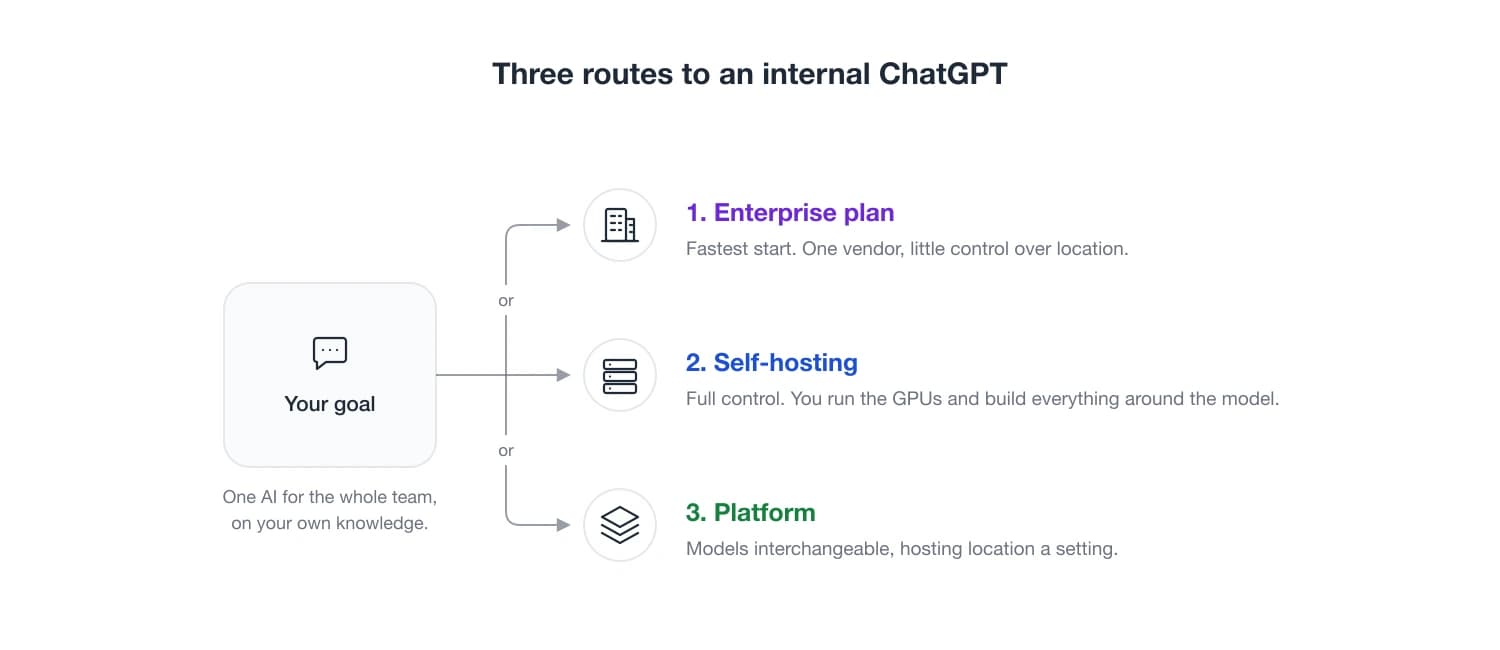
"We'd like an internal ChatGPT" has become one of the most common sentences in our first conversations. It nearly always means the same thing: an AI assistant the whole team can use, one that knows the company's own documents and processes, and where nobody has to worry about confidential material ending up with the wrong provider. What's rarely settled is that there are three quite different routes to it, and they differ less in answer quality than in effort, cost and control.
Why it comes up at all
Usually not because someone decided on an AI strategy, but because employees started long ago. They use free chat tools on personal accounts, and quotes, contracts, customer data and source code walk out of the company with them. The phenomenon has a name, shadow AI, and a ban doesn't fix it: the need is real, and where no approved tool exists, an unapproved one gets used.
An internal GPT is therefore rarely an innovation project. It's usually the answer to a gap that is already open.
The three routes
1. The model provider's enterprise plan. The fastest start: you buy a large provider's business tier, get user management, and an assurance that your inputs aren't used for training. What you don't get is choice, since you're tied to that one provider's models, and usually no control over the server location either. For many teams that is entirely sufficient. For regulated industries it's exactly where legal says no.
2. Self-hosting. Open-weight models have become good enough that running your own internal GPT is realistic. The arithmetic rarely works out the way it looks on paper, though: you need GPU capacity, someone to keep the models current, and you build everything around the model yourself. That includes document indexing, the interface and logging. Sensible if you have a platform team and the requirements are absolute. Expensive if you're only doing it for data protection.
3. A platform on your own knowledge. The middle path: a finished interface and user management, but the models stay interchangeable and the hosting location is a setting rather than a property of the vendor. That's the approach we take with botts.ai. More on our ChatGPT alternative page, and the model overview shows which models you can choose from and which country each one runs in.
What actually decides whether it gets used
The choice of route is usually overrated. Whether an internal ChatGPT is still in use after three months comes down to three far less exciting things.
It has to know your documents. An assistant that gives the same general answers as the public model has no reason to exist. The difference only appears once it has read your price list, your handbook, your project archive, meaning it has a maintained knowledge base behind it. That is also where most projects stall, not on the model, but on knowledge sitting unstructured across five systems.
The hosting location has to be a deliberate decision. Not "somewhere in Europe", but a fact you know and can justify. Which country, which company operates the servers, and which law that company is subject to are three separate questions, and we took them apart in a separate post on data residency. For Swiss companies professional secrecy comes on top, which we cover in the post on ChatGPT in Switzerland.
No training on your data. That should be contractually assured, and not only by the platform but by the model providers behind it. How we handle it is set out on the security page.
Where the time actually goes
Technically, an internal ChatGPT is quick to set up. The work sits in the knowledge base, and that raises questions nobody enjoys answering: which documents should go in at all? Who decides? And who maintains them when the price list changes in the autumn?
That is exactly what quality hangs on. An assistant answering from a clean, maintained archive comes across as smart. The same assistant pointed at a folder holding three versions of the same handbook comes across as unreliable, and staff notice within days. So a narrow start beats a broad one: one department, a manageable set of documents, one task that repeats often. Onboarding is a good first candidate, because the questions are similar every time and the answers are already written down somewhere.
What we almost never see in practice: model quality being the bottleneck.
Wondering which of the three routes fits your company? Get in touch and we'll look at where you stand and tell you honestly whether the effort pays off.